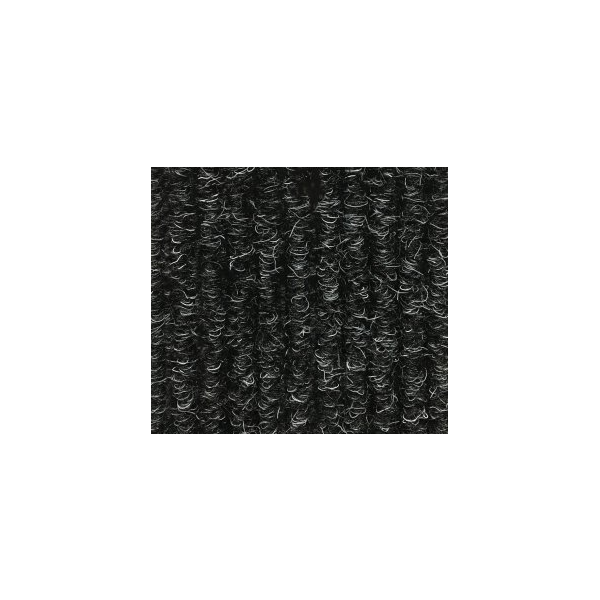
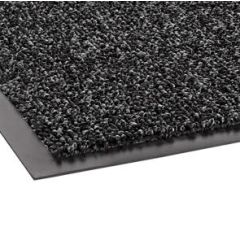
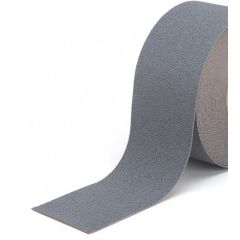
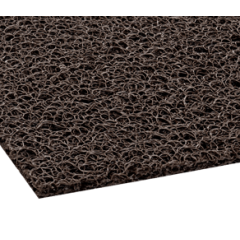
Axis Rib is a needlepunched carpet with a one-by-one corduroy rib running the length of the roll. Its dense 44-ounce polypropylene pile is solution-dyed and UV stabilized, it sits on a composite rubber backing, and it comes in three grays: sterling, charcoal, and black shadow. Of the carpet rolls we cut to length, this is the one that makes a long corridor look longer and hides the traffic lane while it does it.
What Axis Rib Does Before the Traffic Lane Shows
Every entry carpet develops a lane. People walk the same line from the door to the elevator, and within months that strip looks different from the edges: darker where soil settles, flatter where the pile has been pressed ten thousand times. On a flat or pebbled surface the lane reads as a stripe of wear. On a ribbed surface it does not read at all.
That is the corduroy pattern's quiet advantage. Rows of raised ribs and recessed channels already carry a strong line, so a slight flattening in the walking lane disappears into it. Dirt that would sit on top of a flat carpet drops into the channels between the ribs, where a beater-bar vacuum lifts it. The carpet looks even from the door to the far wall for longer.
The stakes past the carpet are the same as for any walk-off surface. Sand and salt that reach polished stone, terrazzo, or sealed concrete scratch the finish, and that finish does not come back with cleaning. Axis Rib's job is to hold that grit in its channels and give the crew a way to remove it before it travels.
Why a Corduroy Rib Needlepunch, and Why This One
Needlepunched carpet is made by tangling loose fibers into a dense felt with barbed needles, rather than stitching yarn through a backing. The felt is then patterned. On Axis Rib the pattern is a one-by-one corduroy: one raised rib, one channel, repeated across the roll. Because there is no stitched row, the material can be cut into any shape without the edge raveling.
The pile is 44 ounces per square yard at 0.18 inch high, on a total height of 0.47 inch and a total weight of 65 ounces per square yard. The maker describes that as heavy fiber in a dense construction and credits it with crush resistance and what it calls long-term comfort underfoot. Among the needlepunched rolls it is the middle weight, heavier than the low-profile options and lighter than the thickest berber.
The fiber is 100 percent solution-dyed, UV-stabilized polypropylene, which means the gray is in the plastic itself, not on the surface. Bleach and sun do not lift it. The color-fastness results on the cut sheet are 5 to light and 5 to water on the ISO 105 scale, and the material is rated stain resistant.
For the spec file, Axis Rib passes ASTM D2859 surface flammability and ASTM E662 smoke density, passes ASTM D7570 for dimensional stability, and is Green Label Plus certified for indoor air quality. It can contribute toward LEED-NC MR Credit 4 and IEQ Credits 4.1, 4.3, and 5.
Where It Belongs and What It Is Not
The maker's suggested uses are lobbies, libraries, department stores, entryways, and other high-traffic areas, plus spaces where people stand for extended periods. That last one is worth noting. A reception desk, a check-in counter, a museum gallery, or a pharmacy waiting line is exactly the kind of spot where a dense 44-ounce pile is more pleasant to stand on than a thin runner or bare tile.
The rib pattern also earns its place visually. Laid with the ribs running the direction of travel, it draws the eye down a corridor and makes a narrow hall feel longer and more orderly. Laid across the direction of travel it reads as a series of bars and the lane shows sooner, so orientation is a real decision, not a detail.
Axis Rib carries an indoor rating on its cut sheet. Use it inside the door: the vestibule, the lobby, the corridor, the standing area. For a covered exterior walkway or an open-air entry, a roll rated for outdoor use is the right tool.
What it is not: a scraper for caked mud, a full anti-fatigue mat for an eight-hour shift, or a runner for pallet jacks and stock carts. Put a rubber or coir scraper ahead of it where boots arrive muddy. Where people stand all day on a hard floor, a purpose-built anti-fatigue mat is the honest answer, and heavy rolling loads belong on vinyl or rubber.
Three Things to Check Before You Spec It
First, which way does the traffic run? Decide the rib direction before you order the cut. Ribs parallel to travel hide the lane and lengthen the space; ribs across travel do neither. For an L-shaped corridor, plan the turn so the ribs on each leg follow that leg's traffic, which usually means two pieces with a seam at the corner rather than one bent run.
Second, confirm it stays indoors. The cut sheet rates Axis Rib for indoor use. A vestibule inside the outer door qualifies. A porch or a walkway under a canopy does not, however dry it looks on a clear day. If the run has to start outside, ask us about an outdoor-rated roll for the exterior leg and Axis Rib for the interior leg.
Third, pick the gray that hides your soil. Three colors are offered. Sterling is the lightest and shows dark tracked-in soil first. Black shadow is the darkest and shows light dust and salt residue first. Charcoal sits between them and is the usual choice where the soil is mixed. Look at what actually comes through the door and match against it, not against the wall paint.
Why Mats Inc.
With Axis Rib the thing that goes wrong is almost never the carpet. It is a roll cut without thinking about rib direction, or a corner laid as one bent piece so the ribs fight the traffic on one leg. We ask how the space is walked before we plan the cut, and for a turn we lay out the two pieces and the seam line for you. Send a sketch with door and corridor dimensions and we will return a cut plan before anything ships.
| Specifications |
|---|
| Construction | Non-woven, needlepunched |
| Surface | One-by-one corduroy rib pattern |
| Fiber | 100% solution-dyed, UV-stabilized polypropylene |
| Backing | Composite rubber |
| Pile height | 0.18" (±0.5 mm) |
| Total height | 0.47" (±7.5%) |
| Pile weight | 44 oz/sq yd (±7.5%) |
| Total weight | 65 oz/sq yd (±7.5%) |
| Roll width | 6' 7" or 13' 2" (±2%) |
| Lengths | 10' to 100' in 10' steps; custom lengths and cut shapes available |
| Use | Indoor |
| Colors | Sterling, Charcoal, Black Shadow |
| Edge | Can be cut to any shape without edge ravel |
| Dimensional stability | ASTM D7570: Pass |
| Flammability | Surface flammability (FF 1-70 / ASTM D2859): Pass; Smoke density (ASTM E662): Pass |
| Color fastness | To light (ISO 105 B02): 5; to water (ISO 105 E01): 5; to shampoo (ISO 105 C06): 4-5; to rubbing (ISO 105 X12): 4 dry, 3-4 wet |
| Indoor air quality | Green Label Plus certified |
| LEED-NC | May contribute to MR Credit 4; IEQ Credits 4.1, 4.3, 5 |
| Maintenance | Vacuum with a motor-driven brush and beater bar: weekly in low-traffic areas, daily or twice daily in high-traffic areas |
| Warranty | 1-year limited (Mats Inc.) |
Frequently Asked Questions
What is a corduroy rib carpet, and how is it different from a berber?
Answered by Dustin Thompson, Owner & CEO
Both start as the same kind of needlepunched felt: loose polypropylene fibers locked together by barbed needles into a dense mat. The difference is the pattern pressed into the surface. A berber has a scattered hobnail bump. A corduroy rib has straight, parallel rows, one rib and one channel repeating across the roll.
In use, the rib gives grit a channel to fall into and a beater bar a straight path to lift it out. It also carries a strong visual line, which is why wear in the walking lane shows later on a ribbed carpet than on a flatter one. At 44 ounces of pile per square yard, Axis Rib has plenty of fiber in those ribs to hold what comes through the door.
How long does Axis Rib last, and what shortens its life?
Answered by Dustin Thompson, Owner & CEO
The maker warrants the material against wear for five years of commercial use, defining wear as complete loss of the wear layer, pattern, and color. In a busy lobby that is a realistic service life with routine care, and a corridor run often goes longer. Because the fiber is solution-dyed and UV stabilized, the gray does not fade; what eventually ends the carpet is matting of the ribs in the lane. Mats Inc. covers this product with a 1-year limited warranty.
What shortens it is soil left in the channels. About 15 percent of tracked-in dirt is oil, which glues grit to the fiber if it sits, and the maker notes that regular beater-bar vacuuming removes up to 80 percent of surface dirt before that happens. Daily in a high-traffic entry, weekly in a quiet hall.
Can Axis Rib go outdoors, and how should it be installed?
Answered by Dustin Thompson, Owner & CEO
Keep it indoors. The cut sheet rates Axis Rib for indoor use, so the right home is the vestibule, lobby, corridor, or standing area inside the outer door. If an entry needs coverage that starts outside, we will pair an outdoor-rated roll on the exterior leg with Axis Rib inside.
On installation, the maker requires professional installation to honor its own warranty. For a long run, a corner, or a doorway with pivoting traffic, set it with adhesive so the leading edge stays flat. A short, straight runner can lay loose on its rubber backing. Whichever method you use, lay the ribs in the direction people walk.
What sizes does it come in, and can you cut it to fit an odd space?
Answered by Jinna Hopson, Vice President of Marketing
The roll is 6 feet 7 inches wide and cut in ten-foot steps from 10 to 100 feet. A 13-foot-2-inch width is available for wide lobbies and double-door entries so the opening can be covered without a seam down the center. Custom lengths between the standard steps are routine.
Odd shapes are fine because the material can be cut into any shape without the edge raveling. The one thing to plan with a ribbed carpet is direction: a corner or an L-shaped hall is usually cut as two pieces so the ribs follow the traffic on each leg. Send a sketch and we will lay out the pieces and the seam for you.
How does the rib pattern read in a finished lobby or corridor?
Answered by Jinna Hopson, Vice President of Marketing
Tailored. The one-by-one rib has the look of fine corduroy or a pinstripe, and in a long corridor the lines pull the eye toward the far end, so the space reads longer and more ordered. In a lobby it reads as a deliberate design choice rather than a utility mat, especially in charcoal or black shadow against light stone.
The three grays are meant to sit quietly with almost any interior palette. Sterling is a light silver, charcoal a true mid-gray, and black shadow a near-black with depth. Because a ribbed surface catches light differently along and across the rows, ask us for a swatch and look at it on the floor, in the orientation you plan to lay it.
Is Axis Rib a good fit for a branded or logo entrance?
Answered by Jinna Hopson, Vice President of Marketing
It is a strong field for a restrained brand presence. The clean-cut edge lets a shape or a wayfinding word be inlaid without fraying, and the corduroy texture gives the surrounding carpet a finished, architectural look that suits law offices, financial lobbies, hotels, and libraries.
With only three grays, it is not the roll for a full-color logo. Use it where the brand is expressed through the building's materials and a tone-on-tone mark, and pair it with a full-palette logo mat at the door if the mark itself needs color. Send your artwork through the proof request on this page and we will return a digital proof before anything is cut.
By Jinna Hopson, Vice President of Marketing, Mats Inc.