




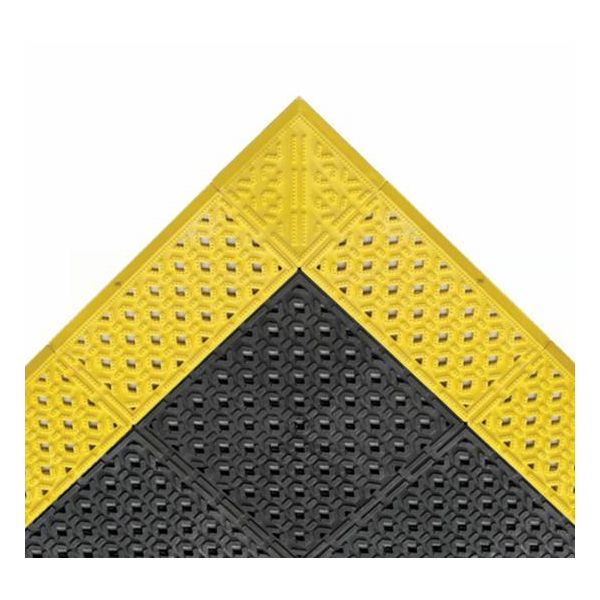
Description
What Cushion-Lok Does Before Spillage Decides Where People Stand
Cushion-Lok is a raised, interlocking drainage mat that turns a wet, oily workstation into a dry standing platform. Hundreds of portholes carry liquids and debris down through the surface, while a series of blades elevates the worker above the spillage — footing stays gripped and dry even when the floor beneath isn't.
On a plant floor, spills don't wait for cleanup schedules. Cutting fluids drift off machines, wash water travels, and the person stationed in the middle of it stands there for a full shift. Without a raised platform, the choice is bad footing or constant mopping. With one, the liquid goes down and the work goes on.
Why Injection-Molded PVC, and Why This One
The material is a tough, injection-molded PVC — with black components manufactured from 100 percent recycled PVC — chosen for its resistance to harsh industrial chemicals, cutting fluids, oils, and greases. That chemistry is what lets the mat live where it's needed most: directly in the splash zone that destroys ordinary rubber and foam.
The build quality reads in the numbers: a 7/8-inch overall thickness, 1.9 pounds per square foot of injection-molded structure, beveled edges, and a heavy-duty usage rating. The manufacturer rates it "Best" — its top tier — for anti-fatigue, slip resistance, and wear resistance all at once, a rare trifecta in one construction.
The compliance sheet is equally clean: the available yellow borders along the sides comply with OSHA code 1910-144, the mat passes US fire rating requirements, it's REACH compliant, and the material is free of DOP, DMF, ozone-depleting substances, silicone, and heavy metals.
Where It Belongs, and What It Is Not
Cushion-Lok belongs in wet, dry, and oily industrial spaces: manufacturing plants, assembly lines, picking, packing and logistics warehouses, and individual work stations wherever spillage meets standing work. Because it interlocks, it's as much a flooring system as a mat — sized to a single post or built out across an entire work cell.
What it is not: a plush front-of-house comfort mat. This is industrial platform equipment, engineered for chemical exposure and heavy duty rather than for a hotel front desk — those softer stations are served by the comfort options in our anti-fatigue mats and runners lineup. Match the tool to the floor, and this one owns the harsh end.
Three Things to Check Before You Spec It
First, decide between stock and built-to-fit. Eight assembled stock sizes run from 30 by 36 inches up to 42 inches by 10 feet — or the interlocking tiles, ramps, and corners let you create your own configuration around machines, columns, and odd footprints. Factory-assembled custom configurations are available too.
Second, plan the borders and transitions. Yellow side borders meeting OSHA code 1910-144 mark the platform edge where forklifts and foot traffic pass close, and the yellow ramp and corner pieces give carts and hurried feet a proper transition onto the raised surface instead of a step up.
Third, match the chemistry to your floor. The PVC resists most chemicals, cutting fluids, oils, and greases — but "most" deserves a check when your process uses something aggressive. Tell us what actually reaches the floor at the station, and we'll verify compatibility before the mat ships.
Why Mats Inc.
Some stations don't need a mat so much as a small piece of infrastructure — and since 1964 we've helped plants build exactly that, one interlocking section at a time. We carry this system for the wet, oily floors that defeat everything simpler, we verify every claim here against the manufacturer's published specifications, and we back it with a 1-year limited Mats Inc. warranty.
| Construction | Raised interlocking drainage mat; porthole drainage surface over blade footing; injection molded |
| Material | PVC; black components manufactured from 100% recycled PVC; resistant to most chemicals, cutting fluids, oils, and greases |
| Thickness | 7/8" |
| Colors | Black, with yellow border options (yellow side borders comply with OSHA code 1910-144) |
| Standard Sizes | 30" x 36", 30" x 48", 30" x 60", 30" x 72", 30" x 96", 42" x 72", 42" x 96", 42" x 120" |
| Modular Components | 12" x 12" tiles (black), 6" x 12" ramps (yellow), 6" x 6" corners (yellow); factory-assembled custom configurations available |
| Edges | Beveled |
| Weight | 1.9 lbs per square foot |
| Ratings | Heavy duty; manufacturer-rated "Best" for anti-fatigue, slip resistance, and wear resistance |
| Compliance | US fire rating: pass; REACH compliant; free of DOP, DMF, ozone-depleting substances, silicone, and heavy metals |
| Use Area | Wet, dry, and oily areas; manufacturing, assembly, picking/packing and logistics, individual workstations |
| Warranty | 1-year limited (Mats Inc.) |
Frequently Asked Questions
How does the raised design actually keep feet out of spills?
Answered by Dustin Thompson, Owner & CEO
Two mechanisms stacked. The surface carries hundreds of portholes, so liquids and debris drop through instead of sitting where shoes land. Beneath the surface, the worker stands on a series of molded blades that elevate footing above whatever collected below — traction up top, spillage down below, and the two never meet. It's the difference between a mat that gets wet with the floor and a platform that stands above it.
Will cutting fluids and industrial chemicals break it down?
Answered by Dustin Thompson, Owner & CEO
Resisting them is this construction's reason for existing. The injection-molded PVC — 100 percent recycled in the black components — was chosen specifically for resistance to harsh industrial chemicals, cutting fluids, oils, and greases, and the manufacturer rates the mat at its top tier for wear resistance on a heavy-duty rating. For genuinely aggressive process chemistry, name the specific exposure and we'll confirm compatibility before you commit a work cell to it.
What does the compliance list actually cover?
Answered by Dustin Thompson, Owner & CEO
More than most mats bother to document. The available yellow side borders comply with OSHA code 1910-144 for safety color marking, the mat passes US fire rating requirements, and the material is REACH compliant and free of DOP, DMF, ozone-depleting substances, silicone, and heavy metals. For facilities where purchasing has to answer to a safety office, that paper trail is part of what you're buying.
Can it really be built around machines and odd layouts?
Answered by Jinna Hopson, Vice President of Marketing
That's the system's signature. Interlocking 12 by 12 inch tiles build the platform in any footprint — an L around a press, a ring around a column, a full runway down a work cell — and the yellow ramps and corners finish every open edge with a proper transition. If assembling it yourself isn't appealing, factory-assembled custom configurations arrive ready to lay down. The mat fits the station instead of the station adapting to the mat.
Which stock size fits a single workstation versus a line?
Answered by Jinna Hopson, Vice President of Marketing
Match the width to the stance and the length to the walk. The 30-inch width covers a single planted post — the 30 by 36 or 30 by 48 for one operator at one machine. Where workers slide station to station, step up to the longer runs: 30 inches by 8 feet, or the 42-inch width at 6, 8, and 10 feet for lines where people pass behind each other. Eight assembled stock sizes cover most stations before custom work even enters the conversation.
What does the yellow border communicate on a busy floor?
Answered by Jinna Hopson, Vice President of Marketing
It draws the official line between the standing platform and everything moving past it. Yellow is the recognized safety-marking color — these borders comply with OSHA code 1910-144 — so forklift operators, cart pushers, and visitors read the platform edge at a glance, from a distance, without a painted line that wears away. And because the border travels with the mat, the marking stays accurate every time the layout changes.
By Dustin Thompson, Owner & CEO, Mats Inc.
Reviews
Write Your Own Review
Related Products

Heritage Personalized Coir Door Mat

Script Name Personalized Coir Door Mat
Monogram Crest Personalized Coir Door Mat
Script Welcome Personalized Coir Door Mat
House Number Coir Door Mat
Coastal Anchor Personalized Coir Door Mat
Laurel Initial Personalized Coir Door Mat
Business Monogram Coir Entrance Mat
#775 Epoxy Flooring Adhesive
#560 Rubber Flooring Adhesive