




More Information
| Manufacturer | Musson Rubber Company |
|---|
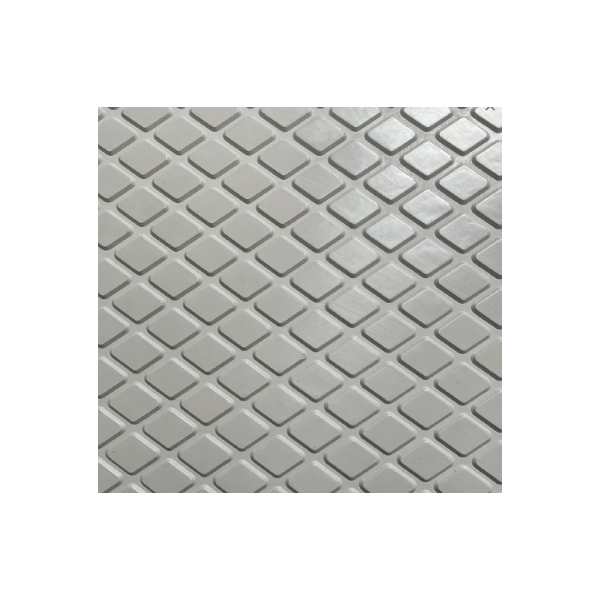
$524.00

Have a question? We're here to help!
Description
A landing takes a kind of abuse the steps never see. People pivot on it, turn on it, set bags down on it, and drag carts across it. Every drop of water tracked up a flight gets deposited there. Cover the treads and leave the landing bare, and the landing becomes the worn spot — and the slick spot — at the exact point where people change direction.
What Diamond Design Rubber Tile Does Before a Landing Wears Out Ahead of the Stairs
Stair treads handle a single motion: a foot lands, presses forward, and lifts. A landing handles everything else. Traffic arrives from one direction and leaves in another, which means twisting loads on the surface rather than straight-line ones. That grinding motion is what polishes terrazzo, wears the finish off concrete, and drives grit into a floor.
Rubber landing tile puts a resilient, textured surface over that pivot point. The rubber absorbs the twist instead of transmitting it into the substrate, and the raised pattern gives shoes something to grip against while they are turning — which is exactly when a smooth wet floor stops working.
The other thing it does is finish the job. A renovated stairwell with new treads and an untouched landing looks unfinished from the flight above, and it cleans as two different surfaces. Tiling the landing means the whole stairwell maintains as one system.
Why a Diamond Pattern in Molded Rubber, and Why This Tile
The diamond pattern is a directional-traction answer to a multi-directional problem. Raised diamonds present edges on every axis, so a foot gets the same grip pivoting sideways as it does walking straight across. A linear rib pattern grips well in one direction and much less well across it, which is the wrong trade on a surface where nobody walks in a straight line.
The tile is 3/16" thick and factory cut to 27" x 27". Factory cutting matters more than it sounds — square, consistent tiles mean tight joints and fewer edges for dirt to work into. The pattern is a continuous field design, so it runs across the joints between tiles rather than resetting at each one, and a tiled landing reads as one surface instead of a grid.
That 3/16" thickness is chosen, not incidental. It matches the thickness of the diamond pattern rubber stair treads it is designed to pair with, so the tile and the tread meet flush at the top of the flight. A thickness mismatch there creates a lip at the busiest transition point in the whole stairwell.
The tile is also made to coordinate with those treads in color and design, so a landing and a flight can be specified as one visual package rather than as two products that happen to be in the same building.
Where It Belongs — and Where It Doesn't
Stair landings are the obvious application, and the one this tile is named for. It also works in lobbies, entrance vestibules, corridors and aisles, elevator cabs and elevator lobbies, ramps, and industrial floor areas — anywhere traffic concentrates, changes direction, or arrives wet. It sits alongside the rest of the interior stair and landing line and is usually specified with matching treads.
It is not a stair tread. There is no nose on a landing tile, so it cannot cover a step edge and should never be used on the steps themselves. The tread and the tile are two different products doing two different jobs on the same flight.
It is also not a loose-lay mat and not an interlocking tile. It is adhered to the substrate, permanently, which is what makes it hold up under cart wheels and pivoting traffic. If you need something removable, or something you can pull up seasonally, this is the wrong product category entirely.
Three Things to Check Before You Spec It
Tile work is won or lost in the layout, before anything is ordered. Three checks will keep the install clean and the cut edges where you want them.
First, measure the landing and plan where the cuts fall. At 27" square, the tile will not divide evenly into most landing dimensions, so there will be cut tiles somewhere. Decide in advance whether the partial tiles sit against the wall, at the stair edge, or split evenly on both sides. Landings are small enough that a badly placed cut row is immediately visible.
Second, check the substrate before ordering. The tile is adhered, so the floor underneath has to be flat, sound, dry, and free of old adhesive ridges. Rubber is resilient enough to conform to minor variation, which is a problem as much as a benefit — it will telegraph a high spot rather than bridge it. Adhesive selection also depends on the substrate, so tell us what you are bonding to.
Third, settle the pattern direction and the color pairing at the same time. Rubber tile carries a subtle marbleization that runs one way through the material, and tiles should be installed with that direction consistent across the landing. Decide it before the crew starts, and decide the tread pairing along with it.
Why Mats Inc.
Mats Inc. has supplied stair and landing coverings since 1964, and landings are the piece most often left off a stairwell order until the treads are already down. We will work the landing dimensions, the tile count, the cut layout, the tread pairing, and the adhesive with you in one pass, so the flight and the landing arrive together and go down together. Send us the measurements and we will do the layout math.
| Material | Molded rubber |
|---|---|
| Pattern | Raised diamond, continuous field design |
| Tile size | 27" x 27" (68.6 cm x 68.6 cm), factory cut |
| Overall thickness | 3/16" |
| Coverage per tile | 5.06 sq. ft. |
| Coordination | Matches diamond pattern rubber stair treads in color and design |
| Traffic rating | Heavy traffic areas |
| Installation | Adhered; adhesive selected to substrate |
| Warranty | 1-year limited (Mats Inc.) |
Frequently Asked Questions
Why a diamond pattern instead of ribs or discs?
Answered by Dustin Thompson, Owner & CEO
Because of how people move on a landing. Ribs are excellent when traffic runs perpendicular to them, which is why they work so well on stair treads — everybody crosses a step the same way. On a landing, nobody does. Traffic arrives from the flight, turns, and leaves in a different direction, often carrying something.
A raised diamond presents edges on every axis, so the grip is the same whichever way the foot is loaded. It also drains: the channels between the diamonds give tracked water somewhere to go instead of sitting as a film. Discs do a similar job with a different look, so the choice between them usually comes down to which pattern your treads use.
Is 3/16" enough for a heavy traffic landing?
Answered by Dustin Thompson, Owner & CEO
Yes, and this is the gauge specified for heavy traffic areas. Rubber does not fail on a landing the way a hard surface does. It deforms under load and recovers, so cart wheels and pivoting feet do not grind material away the way they abrade concrete or polish terrazzo.
There is a second reason 3/16" is the right number, and it has nothing to do with wear: it matches the thickness of the diamond pattern rubber stair treads. Where the top step meets the landing you get a flush transition instead of a lip. That transition is the single highest-traffic square foot in a stairwell, and a raised edge there is a trip point that will get reported.
Can I use this outside, or anywhere other than a stair landing?
Answered by Dustin Thompson, Owner & CEO
Away from stairs, absolutely. This tile is at home in lobbies, entrance vestibules, corridors, aisles, ramps, elevator cabs, and industrial floor areas. Anywhere traffic concentrates or changes direction is a reasonable application, and plenty of buildings use it as a general-purpose floor tile in high-wear zones rather than only on landings.
Exterior use is a different question and I would not want you to assume it. Outdoor installations bring freeze-thaw movement and water sitting under the tile, and the adhesive bond is what carries the whole system. Before you spec this on an exterior landing or an entry step, talk to us so we can confirm the right product and the right adhesive for that exposure.
How do I work out how many tiles I need?
Answered by Jinna Hopson, Vice President of Marketing
Each tile is 27" x 27", which covers just over five square feet. Measure your landing in inches, divide each dimension by 27, and round up on both — that gives you the tile count including the partial tiles you will cut. Do not calculate from square footage alone; it under-orders every time, because cut waste is real.
Then add a few extra tiles. Cuts go wrong, and landings often have a floor register, a door jamb, or a stringer detail that eats a tile you did not plan for. Having two or three spares in a closet also means a damaged tile years from now can be replaced from the same production run rather than a near-match. Send us the landing dimensions and we will run the count for you.
Will the tile match my stair treads, and does the direction matter when laying it?
Answered by Jinna Hopson, Vice President of Marketing
The tile is designed to coordinate with the diamond pattern rubber stair treads in both color and design, so the landing and the flight read as one surface rather than as two products that happen to share a stairwell. That coordination is the main reason to choose this pattern over another.
Direction does matter, and it is the detail installers most often miss. Rubber tile carries a subtle marbleization that runs one way through the material. Lay every tile with that direction consistent and the landing looks like a single poured surface. Rotate tiles ninety degrees to save cutting and you get a visible checkerboard under raking light — impossible to unsee once someone points it out, and it means pulling tiles up.
Can I tile the landing without redoing the stairs at the same time?
Answered by Jinna Hopson, Vice President of Marketing
You can, and sometimes it is the right call — a landing at the bottom of a flight often wears out well before the treads do, especially if it sits near an entrance where everything wet gets tracked in first. Replacing just that surface is a small, contained job.
The thing to think about is the transition. If your existing treads are a different thickness than 3/16", the tile will not sit flush against the top step and you will have a small step-up or step-down at the edge. Usually that is manageable, but it is worth measuring your current tread thickness before ordering rather than discovering it on install day. If you are planning to do the treads eventually anyway, doing both together removes the problem entirely.
Written by Jinna Hopson, Vice President of Marketing, Mats Inc.
Ordering Info
27" x 27" per Tile
3/16" Overall Thickness
6 Tiles per Carton
30 sq ft of Coverage per Carton
Reviews
Write Your Own Review
Related Products
Heritage Personalized Coir Door Mat

#775 Epoxy Flooring Adhesive
#560 Rubber Flooring Adhesive
#110 Epoxy Nose Caulk
#300 Water Based Contact Adhesive
#400 Neoprene Contact Adhesive
Rotary Table & Rig Floor Mats
Fore-Runner Mat
Safety Track Resilient Medium Non-Skid Tape
3M Vinyl Loop Wet Area Matting