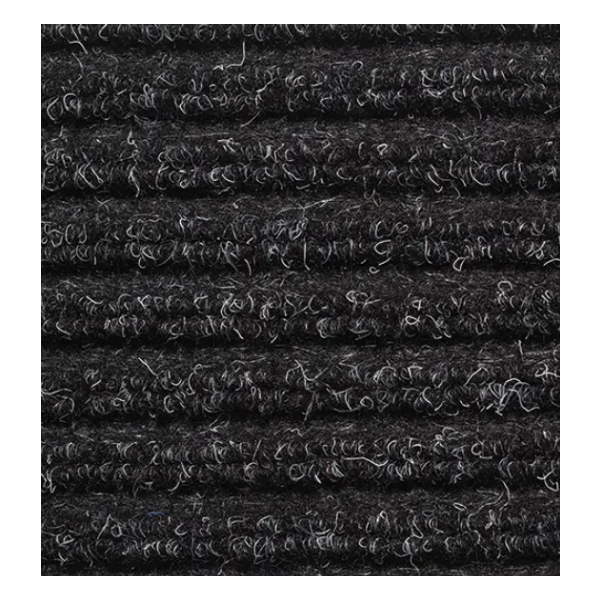
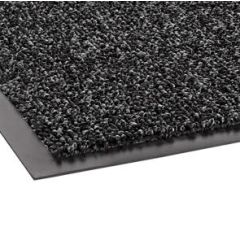
Avenue Rib is a 44-ounce needlepunched carpet with a double-rib pattern, offered in one color: charcoal. The fiber is solution-dyed, UV-stabilized polypropylene on a composite rubber backing, cut to length from 6-foot-7-inch or 13-foot-2-inch rolls. For a facilities team that manages more than one building, it is the commercial carpet roll that turns entry matting into a standard instead of a decision.
What Avenue Rib Does Before Entrances Start to Drift
The quiet failure in multi-site matting is drift. One store orders a gray runner, the next orders a slightly different gray, the third picks a pattern, and within a year the chain's front doors no longer look like the same company. Replacement orders repeat the problem, because nobody remembers which gray the first store had.
Avenue Rib closes that door by having one answer. Every roll is charcoal, every roll carries the same double-rib pattern, and every roll is the same 44-ounce felt on the same rubber backing. A replacement run ordered three years from now will match the original beside it. That is what makes it a specification rather than a purchase.
Underneath the consistency, it does the ordinary job. The rib channels catch the sand and salt that would otherwise scratch stone, terrazzo, or sealed concrete past the mat, and the dense fiber holds water off the hard floor until it dries. The maker rates it for medium-to-heavy foot traffic, which describes most retail, pharmacy, office, and school entries.
Why a Double-Rib Needlepunch, and Why This One
Needlepunched carpet is a felt: loose polypropylene fibers driven together by barbed needles until they lock into a dense mat, then pressed with a surface pattern. No yarn, no stitched rows, so a cut edge stays clean and the material can be shaped to a well or a corner without raveling.
The pattern here is a double rib. Where a single-rib carpet alternates one ridge and one channel, Avenue Rib pairs the ridges, giving a wider ridge and a channel that reads as a bolder line. The maker calls it a uniquely patterned carpet, and the difference is visible from standing height: a firmer, more graphic stripe than a fine corduroy.
The numbers are the same heavy-duty class: 44 ounces of pile per square yard at 0.18 inch high, 65 ounces total at 0.47 inch overall height. The maker credits that density with preventing crushing while keeping the roll easy to move or install. The composite rubber backing grips the floor and keeps moisture in the pile rather than under it.
Solution-dyed fiber means the charcoal is mixed into the polypropylene before it is spun, so it cannot be bleached or sun-faded off the surface. The cut sheet backs that with color-fastness ratings of 5 to light and 5 to water on the ISO 105 scale, and describes the material as resilient in extreme climate conditions.
For the spec binder, Avenue Rib passes ASTM D2859 surface flammability and ASTM E662 smoke density, passes ASTM D7570 for dimensional stability, and carries Green Label Plus certification for indoor air quality. It can contribute toward LEED-NC MR Credit 4 and IEQ Credits 4.1, 4.3, and 5.
Where It Belongs and What It Is Not
The maker's suggested uses are lobbies, libraries, retail and department stores, entryways, and other high-traffic spaces. Its own photography shows the product in a drugstore vestibule, at an elevator bank, and on a stairwell landing, which is a fair picture of where it ends up: the working entries and circulation paths of buildings that see a steady crowd every day.
It fits best where the mat is expected to disappear. Charcoal reads as a neutral against almost any floor, and the double rib gives it enough texture that it does not look like a bare strip. It is the roll for the employee entrance, the back corridor, the elevator lobby, and the chain store front where every location should look the same.
The cut sheet rates Avenue Rib for indoor and outdoor use and attaches a condition to the outdoor rating that it does not spell out. Treat indoor and covered entries as clear, and ask us before specifying it for an exposed exterior location so we can confirm the condition with the maker first.
What it is not: a color choice, a heavy-mud scraper, or an anti-fatigue mat. If the brand needs its own color at the door, a multi-color roll or a logo mat is the right tool. Put a rubber or coir scraper ahead of it where boots arrive caked, and keep pallet jacks and loaded stock carts on vinyl or rubber runners.
Three Things to Check Before You Spec It
First, is one color the right answer for this portfolio? Avenue Rib is the standardizer. If you are writing a matting spec for a chain, a campus, or a property group, a single charcoal roll means every replacement matches and every site orders the same line item. If one flagship location needs a brand color, spec it separately and keep Avenue Rib as the default everywhere else.
Second, plan the rib direction and the run length. Lay the double rib parallel to travel so the channels carry grit along the path rather than damming it. Measure from the door to where the crowd fans out and order that length; rolls come in ten-foot steps from 10 to 100 feet, and the 13-foot-2-inch width covers a double door without a center seam.
Third, settle the exposure. Inside the door or under a solid canopy is straightforward. For an entry that takes direct rain, hold the order until we confirm the maker's outdoor condition for you. It is a one-day question and it keeps the warranty conversation simple later.
Why Mats Inc.
Avenue Rib is the roll we recommend when a facilities manager tells us the last thing they want is another choice. Tell us the roll length, width, and rib direction once, and reordering for the next location or the next replacement becomes a phone call rather than a new spec. If a site turns out to need something the standard cannot do, we will say so and propose the exception rather than bend the standard to fit.
| Specifications |
|---|
| Construction | Non-woven, needlepunched |
| Surface | Double-rib pattern |
| Fiber | 100% solution-dyed, UV-stabilized polypropylene |
| Backing | Composite rubber |
| Pile height | 0.18" (±0.5 mm) |
| Total height | 0.47" (±7.5%) |
| Pile weight | 44 oz/sq yd (±7.5%) |
| Total weight | 65 oz/sq yd (±7.5%) |
| Roll width | 6' 7" or 13' 2" (±2%) |
| Lengths | 10' to 100' in 10' steps; custom lengths and cut shapes available |
| Traffic rating | Medium to heavy foot traffic |
| Use | Indoor; outdoor rating carries a maker's condition (ask before specifying exposed locations) |
| Color | Charcoal (only) |
| Edge | Can be cut to any shape without edge ravel |
| Dimensional stability | ASTM D7570: Pass |
| Flammability | Surface flammability (FF 1-70 / ASTM D2859): Pass; Smoke density (ASTM E662): Pass |
| Color fastness | To light (ISO 105 B02): 5; to water (ISO 105 E01): 5; to shampoo (ISO 105 C06): 4-5; to rubbing (ISO 105 X12): 4 dry, 3-4 wet |
| Indoor air quality | Green Label Plus certified |
| LEED-NC | May contribute to MR Credit 4; IEQ Credits 4.1, 4.3, 5 |
| Maintenance | Vacuum with a motor-driven brush and beater bar: weekly in low-traffic areas, daily or twice daily in high-traffic areas |
| Warranty | 1-year limited (Mats Inc.) |
Frequently Asked Questions
What is a double-rib carpet, and what does the second rib do?
Answered by Dustin Thompson, Owner & CEO
A rib carpet has raised ridges and recessed channels running the length of the roll. In a single rib they alternate one to one. In Avenue Rib's double rib the ridges are paired, so the surface reads as wider bands with a channel between each pair. The base material is the same needlepunched polypropylene felt: fibers locked together by barbed needles rather than stitched as yarn.
In practice the wider ridge gives the shoe a larger bearing surface, and the channel still gives grit somewhere to fall and a beater bar a straight path to lift it. Visually it is a bolder stripe than a fine corduroy, which reads well in charcoal against a light floor.
How long does Avenue Rib last, and what shortens it?
Answered by Dustin Thompson, Owner & CEO
The maker warrants Avenue Rib against wear for five years in commercial use and defines wear as complete removal of the wear layer, pattern, and color. In a medium-to-heavy traffic entry with routine care, five years is a realistic working life, and back corridors and elevator lobbies often go longer. The color does not fade, because it is solution-dyed through the fiber; what ends the carpet is matting in the walking lane. Mats Inc. covers it with a 1-year limited warranty.
Two things shorten it. Soil left in the channels, since roughly 15 percent of tracked-in dirt is oil that bonds grit to the fiber if it sits. And skipping the vacuum: the maker's guidance is that a motor-driven brush and beater bar lifts up to 80 percent of surface dirt, daily in busy entries and weekly in quiet ones.
Can Avenue Rib be used outside, and how should it be installed?
Answered by Dustin Thompson, Owner & CEO
Indoors and under cover, yes. The cut sheet rates the material for indoor and outdoor use and describes it as resilient in extreme climates, but it attaches a condition to the outdoor rating that the sheet does not print. Until we confirm that condition with the maker for your project, treat vestibules, lobbies, corridors, and solidly covered entries as clear, and ask before specifying an exposed location.
On installation, the maker requires professional installation to honor its own warranty. Long runs, corners, and doorways with pivoting traffic should be set with adhesive so the leading edge stays flat; a short, straight indoor runner can lay loose on its rubber backing. Lay the ribs in the direction of travel.
What sizes does it come in, and can it be cut for a recess or a corner?
Answered by Jinna Hopson, Vice President of Marketing
Rolls are 6 feet 7 inches wide, cut in ten-foot steps from 10 to 100 feet, with a 13-foot-2-inch width available for wide lobbies and double doors. Custom lengths between the steps are routine.
Because the needlepunched felt can be cut to any shape without the edge raveling, a recessed well, a curved vestibule, or an L-shaped corridor is straightforward. For a corner, we usually cut two pieces so the ribs follow the traffic on each leg. Send a sketch with dimensions and we will return a cut plan.
What does charcoal Avenue Rib look like in a finished space?
Answered by Jinna Hopson, Vice President of Marketing
Understated and consistent. Charcoal is dark enough to hide the mixed soil most entries see, light enough not to read as black, and neutral enough to sit against stone, tile, wood, or polished concrete without a color argument. The double rib adds a clean linear texture, so the run looks like part of the floor design rather than a utility mat.
The single color is the point for many buyers. A property group or a retail chain can specify Avenue Rib across every location and know the entrances will read the same from one address to the next. Ask us for a swatch if you want to see the charcoal against your floor before ordering a full run.
Can Avenue Rib carry a logo or match our brand colors?
Answered by Jinna Hopson, Vice President of Marketing
Not in color, and that is by design. Avenue Rib comes in charcoal only, so it is the roll for a brand that expresses itself through the building rather than the mat. Its clean-cut edge does allow a tone-on-tone inlay, such as a wayfinding word or a simple mark cut into the field, if a subtle touch is wanted.
Where the brand needs its actual colors at the door, the usual approach is a full-color logo mat at the threshold with Avenue Rib running behind it as the standard field. That keeps the brand moment where people see it and the rest of the run consistent across every location. Send artwork through the proof request on this page and we will return a digital proof before anything is cut.
By Dustin Thompson, Owner & CEO, Mats Inc.