




More Information
| Manufacturer | Musson Rubber Company |
|---|
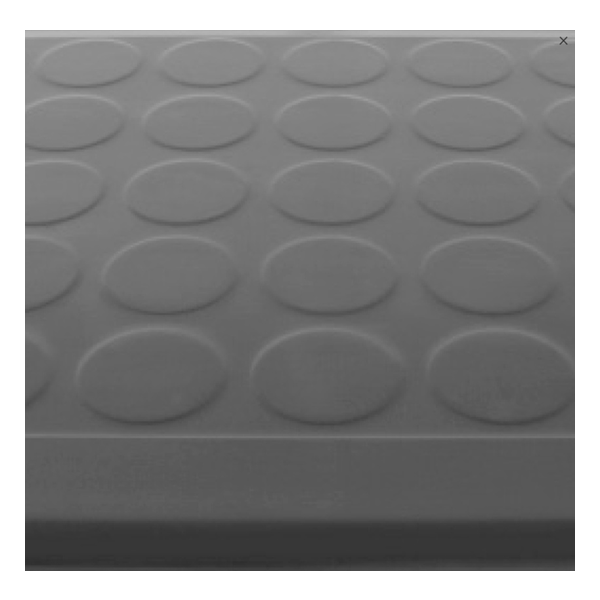
Low Profile Raised Disc Pattern Stair Tread
Product Number:
#820R
$71.00

Have a question? We're here to help!
Description
What a Low Profile Disc Tread Does Before a Stairwell Turns Slick
A stair does not have to be dirty to be dangerous. Plenty of interior stairs are slick because the surface is smooth and the finish is fresh, not because anything got tracked in. A low profile disc tread lays a shallow, repeating texture across the whole step so the sole has something to catch on, in a form that still looks like part of a finished floor.
The discs work by interrupting contact. Instead of one flat plane where a thin film of water or floor polish sits between shoe and surface, the sole meets a field of small raised circles with shallow channels running between them. The film gets pushed aside, the shoe finds rubber, and the step stops behaving like glass the moment it is damp.
Profile depth matters as much as the pattern itself. Texture standing too proud on a lightly used stair traps grit in the low areas and slows every cleaning, and a tread that never gets cleaned properly loses the grip it was specified for. Shallow relief is the working compromise: enough interruption to do the job, little enough to sweep and mop without fighting it.
Why the Low Profile Disc, and Why This One
This is the low profile member of the disc family. The tread is 3/16 inch thick at the front and tapers to a nominal 1/8 inch at the back, over a nominal depth of 12-1/2 inches measured from inside the nose. The nose runs 1-9/16 inches long at 9/64 inch thick, and the whole tread weighs about 1.5 pounds per linear foot.
The nose is fixed, and that is the single most important thing to know before ordering. It is neither tapered nor adjustable, and there is no trim mark molded into the underside. The tread has to suit the step as the step already is, because there is no adjustment available to make it sit down on a nosing it was not sized for.
Set against a high profile disc, this tread trades bite for a flatter walking surface. The shallower relief sweeps and mops with less effort and reads as a quieter, more finished floor, which is why low profile turns up on stairs that are part of the designed space rather than back-of-house. Where shoes arrive wet every morning, the taller profile is the better answer.
For stairs that want more warning at the edge, an abrasive-strip version is available — either 2-3/4 inch strips or a single 2 inch strip. The single-strip configuration is the visually impaired option, using contrast at the leading edge as well as grit. Strip colors are black as standard, with safety yellow, beige, gray, and brown also offered.
Color runs deep here for a technical product. Thirteen colors are stocked, each available in both a solid and a marbleized finish: black, chocolate, charcoal, wine, light gray, medium gray, red, sand, dark blue, brown, light blue, green, and cream. Twenty-six choices is more range than most people expect from a stair tread, and it is the reason these land in specified interiors.
Where It Belongs, and What It Is Not
This is an interior tread built for commercial, industrial, and institutional buildings. It suits stairs in offices, schools, healthcare corridors, and multifamily buildings where the stairwell is a finished space that gets cleaned on a routine and does not take a beating from tracked-in weather. It works as a cover bonded over an existing step, so the step underneath still carries the load.
What it is not is an exterior tread. Outdoor stairs need a compound formulated for UV and freeze-thaw cycling, and this one is specified for interior use only. It is also not the right pick for a stair that takes heavy contamination every day — that is what the deeper disc profile exists for, and specifying the shallow one there is a false economy in traction.
Where it does earn its place, it earns it as part of an assembly rather than alone. Coved risers close the back of the step and cut fitting work at the riser joint, and a matching low profile disc landing tile carries the pattern across landings. It shares adhesive families and the full color range with the rest of the interior stair treads Mats Inc. stocks, so a whole stairwell can be specified in one color.
Three Things to Check Before You Spec It
First, be honest about how the stair gets used and cleaned. Low profile rewards a building with a real cleaning routine and moderate traffic. If the stair sits at the bottom of an entrance run, takes wet shoes daily, or catches grit from a loading area, the shallow relief will not hold up its end and the deeper disc pattern is the correct specification.
Second, measure the step before you order, because this tread will not adapt. Depth is 12-1/2 inches nominal from inside the nose, and the 1-9/16 inch nose is square, fixed, and non-adjustable. Standard lengths run 36 to 72 inches in 6-inch increments, and 72 inches is the ceiling — wider stairs need two treads and a planned seam, not a special order.
Third, settle the rest of the assembly early. Three adhesive families are specified for this tread — acrylic, neoprene contact, and water-based contact — and which one fits depends on the substrate and site conditions, so decide before the treads land on site. If risers and landings are in scope, coved risers and the matching disc landing tile keep pattern and color continuous.
Why Mats Inc.
Stair work punishes assumptions, and this tread punishes them more than most, because a fixed nose gives an installer nothing to work with if the measurement was wrong. Mats Inc. has been specifying commercial stair treads since 1964, and we would rather talk through step depth, nosing shape, and seam placement before an order than sort it out after. We publish the figures the manufacturer documents and say so plainly when a figure does not exist.
| Product type | Interior rubber stair tread cover, low profile raised disc pattern |
| Thickness | 3/16 in., tapering to 1/8 in. nominal at the back |
| Depth | 12-1/2 in. nominal, from inside of nose |
| Nose length | 1-9/16 in. nominal |
| Nose thickness | 9/64 in. |
| Tapered nose | No |
| Adjustable nose | No |
| Standard lengths | 36 in. to 72 in. in 6-in. increments |
| Weight | 1.5 lbs per linear foot |
| Packaging | 6 treads per carton |
| Colors | 13 colors, each in solid and marbleized (26 total): black, chocolate, charcoal, wine, light gray, medium gray, red, sand, dark blue, brown, light blue, green, cream |
| Abrasive strip option | 2-3/4 in. strips or single 2 in. strip; black (standard), safety yellow, beige, gray, brown |
| Installation | Adhesive bonded — acrylic, neoprene contact, or water-based contact adhesive |
| Matching landing tile | 19-11/16 in. x 19-11/16 in. (50 x 50 cm); 1/8 in. overall thickness, 7/64 in. excluding profile; 1/64 in. profile height, 1-9/64 in. profile diameter; 16 tiles / 43 sq. ft. / 42 lbs per carton |
| Application | Interior use |
| Warranty | 1-year limited (Mats Inc.) |
Frequently Asked Questions
How much traction does a shallow disc pattern actually give up?
Answered by Dustin Thompson, Owner & CEO
Less than people assume on a clean stair, and more than they assume on a dirty one. The mechanism is the same either way: the discs break up the flat plane so a film of water or floor finish cannot sit continuously between the sole and the rubber. On a dry, maintained stair the shallow pattern does that job as well as a deep one.
The gap opens when the surface gets contaminated. Deeper relief has more room to push water and grit out of the contact area, so it keeps working further into a bad day. If the stair regularly sees wet shoes or tracked-in debris, that headroom is worth buying. If it does not, you are paying for texture that mostly makes cleaning harder.
How thick is this tread, and how does the fixed nose affect installation?
Answered by Dustin Thompson, Owner & CEO
It is 3/16 inch at the front, tapering to a nominal 1/8 inch at the back across a nominal depth of 12-1/2 inches from inside the nose. The nose is 1-9/16 inches long at 9/64 inch thick. At about 1.5 pounds per linear foot, it is a lighter tread than the deep-profile version and easier for one person to handle on a stair.
The fixed nose changes how installation goes. There is no taper and no adjustment, so the tread cannot be coaxed onto a nosing that is a different shape or drop than it expects. That makes the pre-order measurement the whole job. Get it right and installation is straightforward; get it wrong and there is no field remedy short of a different tread.
Can these go outside, and what does the step underneath need to be like?
Answered by Dustin Thompson, Owner & CEO
Not outside. This is an interior specification. Exterior stairs need a compound built for UV exposure and freeze-thaw movement, and an interior tread put outdoors gives up service life and stresses the adhesive bond in ways it was never chosen for. If the stair is exposed to weather, ask us for the exterior tread instead.
Indoors, the tread bonds with adhesive — acrylic, neoprene contact, or water-based contact are the three specified. Whatever the step is built from, the surface needs to be sound, clean, and dry before adhesive goes down. Bond a tread over dust or trapped moisture and it lifts at the nose first, which is the one edge you cannot afford to have loose.
What lengths are available, and what do I do about a wide stair?
Answered by Jinna Hopson, Vice President of Marketing
Standard lengths run 36 to 72 inches in 6-inch increments, and 72 inches is the ceiling on this profile. Depth is fixed at 12-1/2 inches nominal from inside the nose, and the nose is not adjustable, so length is genuinely the only dimension you are selecting. Treads pack six to a carton at roughly 1.5 pounds per linear foot.
Anything wider than 72 inches means two treads and a seam. That is normal on institutional stairs, but decide where the seam lands rather than leaving it to the installer — centered looks deliberate, off-center looks like a mistake. Measure every step individually too, because stairs built decades apart in the same building rarely agree with each other.
What colors are there, and how do I choose one for a stairwell people actually see?
Answered by Jinna Hopson, Vice President of Marketing
Thirteen colors, each offered in a solid and a marbleized finish, so 26 in all: black, chocolate, charcoal, wine, light gray, medium gray, red, sand, dark blue, brown, light blue, green, and cream. We can send the current color card before you commit, because a color on a screen and a color on a stair are two different things.
For a visible stairwell, the choice usually comes down to how much soil you want to see between cleanings. Marbleized carries scuffs and tracked grit without looking neglected, which is why it dominates in schools and healthcare. Solids read cleaner and more contemporary and suit a stair that gets attention, particularly in charcoal, sand, or light gray against a painted riser.
Do the risers and landings match, and does the landing tile really line up with the tread?
Answered by Jinna Hopson, Vice President of Marketing
They do, and matching them is what separates a specified stairwell from a patched one. Coved risers pull the same color up the riser face so the stair reads as a single surface, and they reduce the fitting work where tread meets riser at the back of the step.
The landing tile is the piece people forget. The low profile disc tile measures 19-11/16 inches square at 1/8 inch overall thickness, with the disc pattern standing 1/64 inch proud — a genuinely shallow relief, against 3/64 inch on the high profile tile. Each carton covers 43 square feet. Specify tread, riser, and tile in one color and the pattern never stops and restarts at a landing.
By Jinna Hopson, Vice President of Marketing, Mats Inc.
Reviews
Write Your Own Review
Related Products
Super Scrape Rubber Mats
Safety Track Non-Skid Tape - Coarse

Smooth Marbleized Vinyl Switchboard Matting (Mil Spec)
Super Scrape Rubber Logo Mats
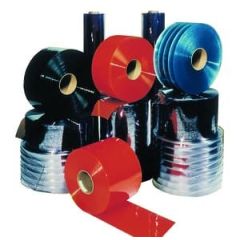
Strip Doors
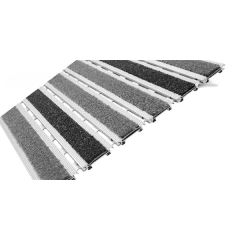
Perfec Clean 3/8" Rollup Mats - Aluminum Hinge
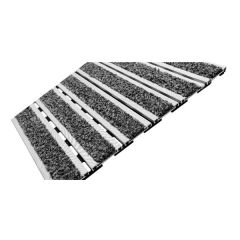
Perfec Clean 3/8" Rollup Mats - Rubber Hinge
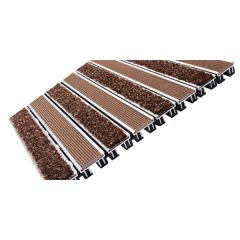
Perfec Clean 3/4" Rollup Grate - Rubber Hinge
Perfec Clean 1-5/8" Grate
WP-70 Non-Skid Epoxy Coating