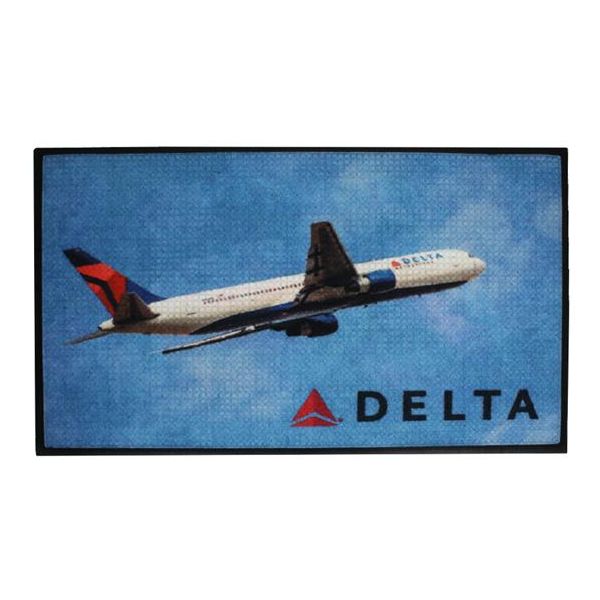
A printed Waterhog logo mat does two jobs at once: it puts your name or logo at the door, and it does the real work of a Waterhog — scraping grit and holding water before either reaches your floor. That pairing is the whole point. A logo on a thin promo mat wears off and curls; a logo printed into a genuine Waterhog entrance mat keeps working long after the first impression lands.
What a Printed Waterhog Logo Mat Does Before Grit Reaches Your Floor
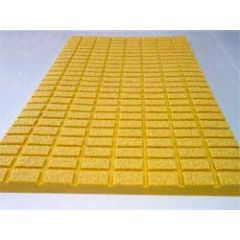
Every entrance makes two impressions at once — what visitors see, and what their shoes leave behind. A printed Waterhog logo mat handles both. The bi-level surface scrapes dirt and moisture off shoes and drops it down between the raised nubs, below shoe level, so it stays in the mat instead of tracking across your lobby.
The raised water-dam border holds that moisture in — up to 1.5 gallons of water per square yard — so the floor behind it stays dry. Your logo sits on a surface that's actually doing the cleaning, not just decorating the doorway.
Why This Construction Holds Up Where a Promo Mat Won't
The surface is a 30 oz/yd² PET polyester fiber, needle-punched into the raised Waterhog nub pattern and bonded to a molded nitrile rubber backing. The reinforced rubber nubs are what keep the pile from crushing flat under traffic — the usual way a logo mat dies, with the print going patchy as the surface mats down. Here the nubs hold the pile up, so the image stays crisp and the mat keeps scraping.
The logo is built up through a color-layering print process rather than sitting on top as a coating, and the PET fiber is made largely from recycled plastic — up to 85% recycled content. The nitrile backing resists curling and cracking in heat or cold, which is what lets the same mat work at an indoor lobby or a covered outdoor entrance.
Where It Belongs — and What It Isn't
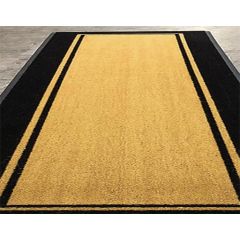
This is a commercial entrance mat first and a sign second. It earns its place at front doors, lobbies, reception areas, and front desks — anywhere in hotels, retail, restaurants, offices, schools, and healthcare where the first thing a visitor meets is the floor. Pick smooth backing for hard floors and cleated backing for carpet.
What it isn't is a canvas for fine detail. The print reproduces bold logos, lettering, and clean shapes — not photographic gradients, tiny text, or thin hairlines. Text should be at least 1.5 inches tall and lines at least a quarter-inch thick. Very light background colors are best avoided, since pale fields show everyday soil faster than darker or neutral tones.
Three Things to Check Before You Spec It
First, match the backing to the floor it's going on. Smooth backing grips hard surfaces like tile, stone, and sealed concrete; cleated backing is made to sit on carpet without creeping. Getting this wrong is how a mat slides or ripples underfoot.
Second, pressure-test your artwork before you commit to it. Bold logos and clear lettering reproduce beautifully; gradients, screens, and PMS-specific color matching don't. Build the design around at least 1.5-inch text and quarter-inch lines, and lean toward a darker background that hides soil between cleanings.
Third, size the mat to the entrance, not just the doorway. People need several steps on the surface to leave their dirt behind, so a mat that spans the actual walking path cleans far better than a small one tucked at the threshold. Measure the opening and the stride past it before you choose a size.
Why Mats Inc.
Mats Inc. has specified commercial entrance matting since 1964, and a logo mat is where performance and presentation have to land together — get one right and the other wrong, and the mat fails at the door. We help you spec both: the surface and backing for how the entrance is used, and the artwork so it actually reproduces on the mat. You'll see a proof before anything is produced, and the order is backed by our one-year limited warranty.
Waterhog Printed Logo Mat — Specifications
| Surface fiber | PET polyester, 30 oz/yd², needle-punched |
| Surface pattern | Bi-level raised-nub (waffle) walk-off surface |
| Recycled content | Up to 85% recycled PET |
| Backing | Molded nitrile rubber — smooth (hard floors) or cleated (carpet) |
| Backing thickness | 65-mil body / 155-mil border |
| Border options | Classic rubber or fashion fabric (rubber border is commercially launderable) |
| Water retention | Up to 1.5 gallons per square yard |
| Edges | Beveled for a safe floor-to-mat transition |
| Traction | NFSI-certified high-traction |
| Color options | 56 standard colors |
| Artwork minimums | Text ≥ 1.5"; lines ≥ 1/4"; no PMS matching, gradients, or transparencies |
| Placement | Indoor and covered outdoor commercial entrances |
| Warranty | One-year limited (Mats Inc.) |
Frequently Asked Questions
How can a mat show a logo and still keep my floors clean?
Answered by Dustin Thompson, Owner & CEO
Because the logo is printed into a working Waterhog surface, not onto a flat promo mat. The bi-level pattern of raised nubs scrapes grit and moisture off shoes and traps it down below shoe level, while the water-dam border holds water on the mat — up to 1.5 gallons per square yard. So the printed surface is doing the same scraping-and-holding job as a plain Waterhog; the artwork just rides on top of it. Your logo greets people while the mat quietly keeps the lobby floor dry.
How long will the logo and the mat hold up under traffic?
Answered by Dustin Thompson, Owner & CEO
The thing that usually kills a logo mat is pile crush — the surface flattens under foot traffic and the print goes patchy. This construction fights that with reinforced rubber nubs that hold the pile upright, so the image stays crisp and the mat keeps working through heavy use. The nitrile backing resists curling and cracking in heat and cold, and a rubber-bordered mat can even be commercially laundered. Kept clean and sized right, it holds up for years, and Mats Inc. backs every order with a one-year limited warranty.
Can I use it both indoors and outdoors, and which backing do I pick?
Answered by Dustin Thompson, Owner & CEO
It works at indoor lobbies and covered outdoor entrances alike, because the PET fiber and nitrile backing handle moisture and temperature swings without breaking down. The backing is the choice to get right: smooth backing for hard floors like tile, stone, or sealed concrete, and cleated backing for carpet, where it grips instead of creeping. For a fully exposed outdoor spot that takes constant sun and standing water, talk to us first so we can match the mat to the conditions.
What can I have printed on the mat?
Answered by Jinna Hopson, Vice President of Marketing
Bold logos, lettering, and clean shapes reproduce really well. The print is built up in color layers, so it's made for crisp, well-defined artwork rather than photographic gradients or fine detail. Keep text at least 1.5 inches tall and lines at least a quarter-inch thick, and skip tints, screens, and transparencies. PMS color matching isn't available, but there's a wide standard palette to build from. Send us your artwork and we'll show you how it translates to the mat before anything is made.
What colors does it come in, and does the background matter?
Answered by Jinna Hopson, Vice President of Marketing
There are 56 standard colors to build the logo and background from, which is plenty to match most brand palettes. The one thing worth planning around is the background tone: very light or white fields look sharp on day one but show everyday soil faster than darker or neutral colors. For an entrance that gets real traffic, a mid-tone or darker background keeps the mat looking intentional longer between cleanings, while your logo still reads clearly on top.
What sizes can I get, and how do I pick the right one?
Answered by Jinna Hopson, Vice President of Marketing
It comes in a wide range of standard sizes, from a small 2-by-3 up through long runners and large lobby formats, so you can fit a single door or a wide entrance. The trick is to size it to the walking path, not just the doorway — people need several steps on the mat to leave their dirt behind, so a mat that's too short lets grit slip past. Measure the opening and the few steps beyond it, and we'll help you land on a size that both fits the space and shows the logo well.
By Jinna Hopson, Vice President of Marketing, Mats Inc.